
In today’s world, your bio is your most valuable asset. With TikTok and Instagram full of food trends, your bio stands out.
It’s more than just a bio. It’s your culinary vision, your story, and your first impression. It’s like the trailer for your career.
Take Chef Heatley, who went from a 1976 Chevy Malibu to a hot pepper farm. Or Juan Manuel Lopez Palacios, who began in his mother’s kitchen in Buenos Aires.
These aren’t just resumes. They’re stories with depth. So, why is a good chef bio so important today?
In a sea of food content, it’s what makes you memorable. We’ll explore how to tell your story well.
Elements of a Memorable Bio
What makes a bio stand out? It’s the mix of personal and professional elements. Your chef introduction is like a dish that people want to try. It combines your experience with a story that grabs attention.
A good bio is like a tasting menu. It starts with a hook, then tells your journey, and ends with your philosophy. It’s more than just a list of jobs. It’s a story with twists and turns.
The best bios blend these elements together. They’re not separate parts, but flavors in your story.
- The Narrative Hook: This is your “origin story.” It could be your abuela’s kitchen or a need for car insurance money. It’s the emotional start that answers the “why” before the “what.”
- The Culinary CV/Resume: Every job, no matter how small, is important. It shows your skills and experiences. It’s not just about the title, but what you’ve learned.
- Visual Proof (Photographs & Media): Pictures of your food can speak volumes. Include headshots, food photos, and media logos. They show your talent and style.
- Recipes & Special Projects: Show your creativity with recipes or unique dinners. It gives a taste of your style and creativity.
- Awards & References: Let others praise you. This is the proof that backs up your story. It’s the final touch after you’ve shared your journey.
- Personal Touches & Philosophy: What drives you? Is it sustainability or bold flavors? This connects your work to a bigger idea. It’s the why behind your what.
- Online Presence Links: Your bio is the center, and your social media is the spokes. Make it easy for people to explore more.
These elements work together. Your philosophy should shine in your projects. Your visuals support your CV. It’s a system, not a checklist.
The old way was a static bio. Now, it’s a dynamic platform. It’s a story, a portfolio, and a mission statement. It shows where you’ve been and where you’re going, and makes you want to follow.
Before you start writing, check your ingredients. Do you have a hook? Do you have visuals to back up your claims? Is your philosophy clear? Getting this right makes you memorable, not just another name.
Telling Your Culinary Story
Your culinary story is not just a list of jobs. It’s a journey of growth and passion. In your chef about me section, you can share your unique story. It’s your chance to stand out in a crowded field.
Take Chef Heatley, for example. He didn’t start in culinary school. He left a desk job to chase his dream of a sauce empire. Juan’s story is similar. He found his passion in a private chef business in Costa Rica, not in another top kitchen.
So, how do you tell your own story for your chef about me section? Let’s break it down.
The Call to Adventure: Was it a first job in a kitchen, or sneaking your mom’s pastry? Find that moment.
The Mentors & Trials: Who helped you grow? What challenges made you better? These are your journey’s highlights.
The Return with the Elixir: This is your signature dish. It shows your culinary wisdom. It’s the result of your hard work.
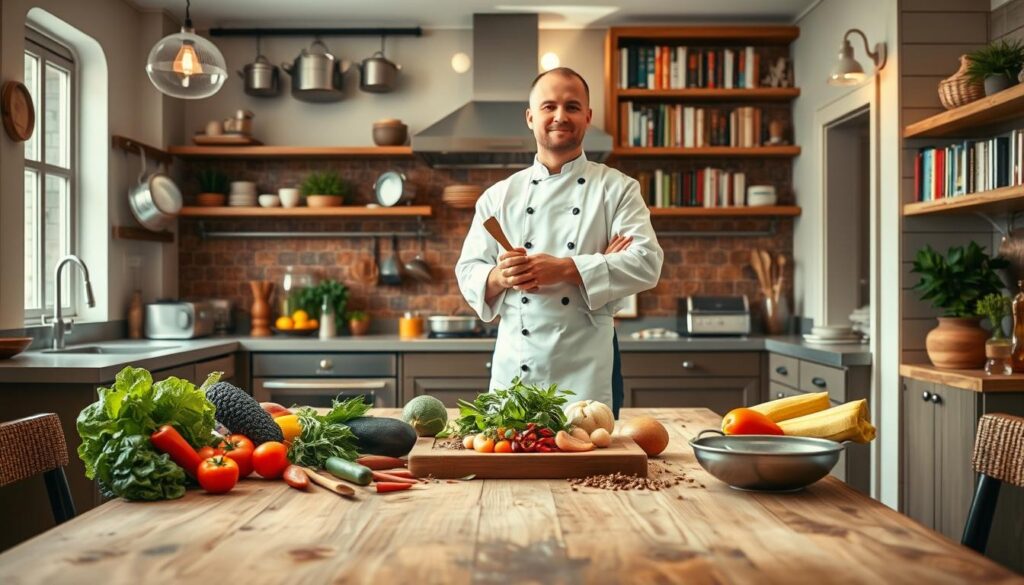
Seeing your career this way makes your story meaningful. It shows you’re not just a cook. You’re a storyteller. This approach helps you create your brand story with depth.
Your bio should tell why you cook, not just that you do. It shows the journey that led to your passion. That’s the story in your chef about me.
Tips for Tone & Style
Voice in a chef bio is key. It makes you sound interesting or just another chef. You could be serious, bold, or funny. Your choice draws people in.
Chef Heatley’s bio is witty and smart. He talks about his “fully loaded” Malibu and Ozzy cassette. This shows he’s serious but not too serious. It makes readers like him right away.
Short sentences grab attention. “I cook. I create. I occasionally burn things.” Long sentences explain more. This keeps readers interested. Asking questions makes them think along with you.
Adding personal touches makes your bio stand out. Talk about your mentors, kitchen mishaps, or hobbies. These humanize you, making you more relatable.
Choosing your tone is a smart move. Look at brand tone examples to find your voice. Here are some common chef types to help you decide.
| Culinary Persona | Core Characteristics | Example Phrase | Best For |
|---|---|---|---|
| The Stoic Craftsman | Precise, technical, humble. Focuses on ingredients and tradition. | “My philosophy is simple: respect the product, and it will respect you.” | Fine dining, farm-to-table, and culinary purists. |
| The Fiery Revolutionary | Passionate, disruptive, opinionated. Challenges conventions. | “I’m here to break rules, not just eggs. Comfort food is a lie we tell ourselves.” | Avant-garde cuisine, food critics, and concept restaurants. |
| The Witty Sage | Analytical, humorous, culturally aware. Uses stories and sarcasm. | “My signature dish was born from a failed experiment and a stubborn refusal to order takeout.” | Media personalities, cookbook authors, and elevated casual dining. |
| The Gracious Host | Warm, inviting, narrative-driven. Emphasizes community and experience. | “Every plate tells a story from my grandmother’s kitchen to yours.” | Catering, family-style restaurants, and culinary educators. |
Your chef bio should feel like you. Mix in cultural references and kitchen wisdom. Be both sophisticated and easy to understand. A short sentence can be funny, while a long one can build a story.
Style is as important as substance. How you arrange your words matters. A clever phrase can be more memorable than many awards. Almost.
Integrating Keywords for SEO
Let’s face it: your cooking philosophy is like poetry, but Google’s algorithm only understands keywords. Even if you write beautifully about the perfect consommé, if your bio doesn’t match what Google expects, no one will find it. This is the not-so-glamorous side of the internet—SEO. Without it, your story goes unnoticed.
Your online presence is like a new store. Being found online is not just about looking good; it’s about being seen. If someone searches for a “private chef in Austin” or a “top pastry chef,” they won’t find you if your chef introduction doesn’t have the right keywords. Your goal is to make these keywords blend in so smoothly, they seem like part of your story, not a list.
Finding the right keywords starts with knowing your audience. Are they food lovers looking for “sustainable seafood specialists”? Or event planners searching for “creative catering chefs for weddings”? These are your main keywords. They should add flavor to your story, not overpower it.
The trick is to weave these keywords into your narrative. Mention working at a famous New York kitchen? Tag it as “working with an award-winning chef.” Talk about your commitment to farm-to-table? That’s your chance to be a “sustainable cuisine advocate.” It’s a balance between creativity and SEO, where every mention of your favorite book sits well with search terms.
To do this well, you need to know where to put your keywords for the best effect. Not all parts of your bio are equally important to search engines.
| Element of Your Bio | SEO Priority | Keyword Integration Tip | Natural Narrative Hook |
|---|---|---|---|
| Title Tag / Page Title | Critical | Start with your main role (e.g., “Executive Chef Maria Chen | Modern Italian Cuisine”). | This is your first impression—make it clear and professional. |
| First 100 Words | High | Put your core “chef introduction” keyword and location or specialty early. | Start strong with who you are and what you do. |
| Headers (H2, H3) | High | Use descriptive headers like “My Journey as a Private Chef” or “Philosophy on Plant-Based Cooking.” | Headers help organize your story for readers and search engines. |
| Meta Description | Moderate | Write a compelling 155-character summary that includes a key phrase. It’s your ad copy. | This snippet is what people see in search results—entice them to click. |
| Body Text & Anecdotes | Foundation | Sprinkle secondary keywords (e.g., “from-scratch baking,” “global flavor fusion”) naturally in stories. | This is where your personality shines; keywords should feel like part of the conversation. |
Notice the difference? The technical parts (Title Tag, Meta Description) are for machines. The body text is for people. Your task is to please both. A bio full of keywords feels like spam. A beautiful bio without them is like a tree falling in a forest with no one to hear it.
How do you check if your chef introduction is good? Read it out loud. If something sounds unnatural, like “innovative culinary artist specializing in hyper-local gastronomy,” it probably is. Change it to something like “chef focused on local ingredients.” It’s simpler, more direct, and easier to find.
SEO isn’t about fooling a system. It’s about telling your unique story in a way search engines can understand. It’s like building a bridge between your amazing cooking and the hungry world. Use smart keywords to build that bridge, and watch your online dining room fill up.
Where to Publish Your Bio
In today’s world, your story needs to be everywhere. A chef about me bio on just one page is like a dish in an empty room. It’s beautiful but unseen. You must spread your story far and wide.
Imagine you’re a media empire of one. Your story, crafted with care, must reach every corner. Each version is tailored for its audience.
Your website is your base. It’s where your full chef about me story lives. It’s for those who want to know everything about you.
Social media is where you grab attention. Instagram is all about visuals. Share a stunning dish or a peek into your kitchen. Your bio should be short and sweet, with a link.
LinkedIn is for the boardroom. Here, your chef about me story highlights your experience and achievements. Share your kitchen successes to impress recruiters and hotel VPs.
Don’t overlook platforms like Chef’s Roll or StarChefs. They’re where culinary insiders meet. Your bio should show off your skills and awards, and your desire to work with others.
To succeed, you need a plan. The table below shows how to share your bio across different platforms.
| Platform | Primary Audience | Bio Focus | Tone Adjustment |
|---|---|---|---|
| Personal Website | Discerning diners, journalists, super-fans | Complete journey, philosophy, full accolades | Authoritative, detailed, and welcoming |
| Food enthusiasts, customers, visual followers | Visual hook, one-line philosophy, immediate CTA (link) | Casual, aspirational, and engaging | |
| Corporate recruiters, hotel groups, suppliers | Leadership, achievements, business growth | Professional, accomplishment-driven, and network-oriented | |
| Restaurant Site | Prospective guests, gift card buyers, local community | Connection to the restaurant’s concept, guest experience | Inviting, story-driven, and locally focused |
| Chef’s Roll / StarChefs | Industry peers, event organizers, culinary judges | Technical skills, competition history, collaboration interest | Respectful, skilled, and open to opportunity |
This isn’t about making five different biographies. It’s about highlighting different parts of your story for different audiences. Your Instagram bio is like a thrilling trailer. Your LinkedIn profile is like a director’s commentary on leadership. Your website is the full feature film.
Mastering this approach turns your chef about me into a dynamic, living entity. It ensures you’re found, understood, and remembered. Whether someone is looking for dinner ideas or a new chef, you must be there.
Regular Updates
In today’s fast-paced food world, a static chef bio is as useful as a dull knife. That glowing profile celebrating your “recent” stage at a trendy restaurant? It now feels like a culinary history lesson. The truth is, your professional story is never complete.
Your bio needs to be like a sourdough starter—a living document that grows with time. New achievements, changed views, and fresh references are what keep it alive. A bio that doesn’t change becomes outdated and misleading.
This isn’t just about showing off. It’s about keeping your bio fresh and relevant. Did you land a pop-up residency or a major press feature? Update your chef bio. Did you master a new cuisine or technique? That’s a bio update. Did you change your views on sustainable sourcing? Absolutely an update.
The aim is to keep your online image as fresh as a well-aged wine, not like yesterday’s food. To keep this up, do a quarterly bio audit. This isn’t a complete rewrite, but a strategic review and tweak.

- Prune the Jargon: Look for buzzwords that have lost their meaning or relevance. Does “farm-to-table” really capture your current ethos, or has it evolved?
- Chronology Check: Is your career timeline up to date? Have you added that recent consulting gig or award nomination? An outdated timeline can hurt your credibility.
- Philosophy Pulse: Re-read your mission statement. Does it align with your current kitchen practices and beliefs? Your culinary view should evolve.
- Achievement Inventory: Add any new milestones—collaborations, menu launches, mentorship roles. These show your growth.
- Tone Tune-up: Does the voice in your bio sound like you? As your career grows, your bio’s tone might change from eager newcomer to respected authority.
This regular update turns your chef bio into a dynamic, engaging part of your story. It shows clients, collaborators, and the media that you’re actively involved in your craft. Your bio should be a preview of the amazing chef you are today, not a look back at who you used to be.
Conclusion
Think of your chef bio as your culinary handshake. It’s not just listing your resume. It’s the story you tell before you start cooking.
We’ve shown you how to write it. Your story is the main ingredient. Your tone and style add flavor. Using the right keywords makes you easy to find. Sharing it online is like serving your dish.
Chef Heatley’s bio does more than list his skills. It invites you to meet him at the market. Your bio should thank your community and invite them to join you.
This is your chance to create your own legend. A great chef introduction leaves the door open. Now, write your own bio. The kitchen and your fans are waiting.