
In today’s world, we often trust online reviews more than our own family’s advice. This shift in how we make decisions is quite strange but true.
Online reviews play a huge role in our choices. A whopping 93% of people say reviews affect their buying decisions. Almost half believe in these reviews as much as a personal recommendation.
For chefs and other service professionals, this is more than just numbers. It’s how we operate today. Word-of-mouth has found a new voice online.
Imagine choosing a chef based on a menu alone. Or would you look for the real stories in client testimonials?
Showing real reviews can really help. It can increase sales by 270%. This isn’t just nice to have. It’s essential for building trust in a world full of doubts.
A great chef testimonial is more than just feedback. It’s like shaking hands with your next dinner host. It proves your worth in a way ads can’t.
How to Request Testimonials
Asking for a testimonial is not about begging. It’s about timing it right, like catching applause. We can avoid the awkward silence. The goal is to turn a vulnerable moment into a way to gather social proof.
Start with ethics. You’re building trust, not a toll booth. Never coerce or incentivize. Asking for a review in exchange for a discount is a bad idea. It hurts your credibility. Your request should feel like an invitation, not a deal.
Timing is key. Ask when the experience is fresh. For chefs, this is right after a great meal, not when they’re cleaning up. The idea is to ask when satisfaction is at its peak, not during the hard work.
Make it easy for people to respond. A vague “Let me know what you think!” gets lost. Instead, guide them: “If your experience was good, sharing a few words here helps others.” A direct link or a simple survey is the best way to make it easy.
This method turns a plea into a gentle nudge. It collects useful reviews for chefs and others. The table below shows how to build your library without making people resentful.
| Tactic | Why It Works (or Doesn’t) | Ideal For |
|---|---|---|
| Direct Link Sent Post-Event | Works well when satisfaction is fresh. It’s easy for clients. | Event-based services (e.g., catering, consulting sessions). |
| Vague, Open-Ended Email Ask | Fails because it’s unclear. It makes clients tired of deciding. | Nowhere. It’s like whispering into a hurricane. |
| One-Question Post-Service Survey | Very effective. It’s quick, focused, and gets good quotes. | Any service where a simple question works. |
| Incentivized or Paid Review | Bad because it’s fake. It breaks trust and ethics. | A short-term plan that harms your reputation long-term. |
| Single, Gentle Follow-Up | A polite reminder. Okay if the first ask was good. | Happy clients who forgot to respond. |
The strategy is clear. Ask at the right time and make it easy. A simple system turns happy clients into your best advocates. They give you real reviews for chefs and others. That’s how you build trust without embarrassment.
Showcasing Comments Effectively
Turning praise into social proof is like curating a gallery, not just collecting photos. You have the success stories—the glowing quotes. Now, it’s time to create the exhibit.
Analytics and art come together here. Your chef credibility shines through not just by dishes, but by the relief in a client’s story.
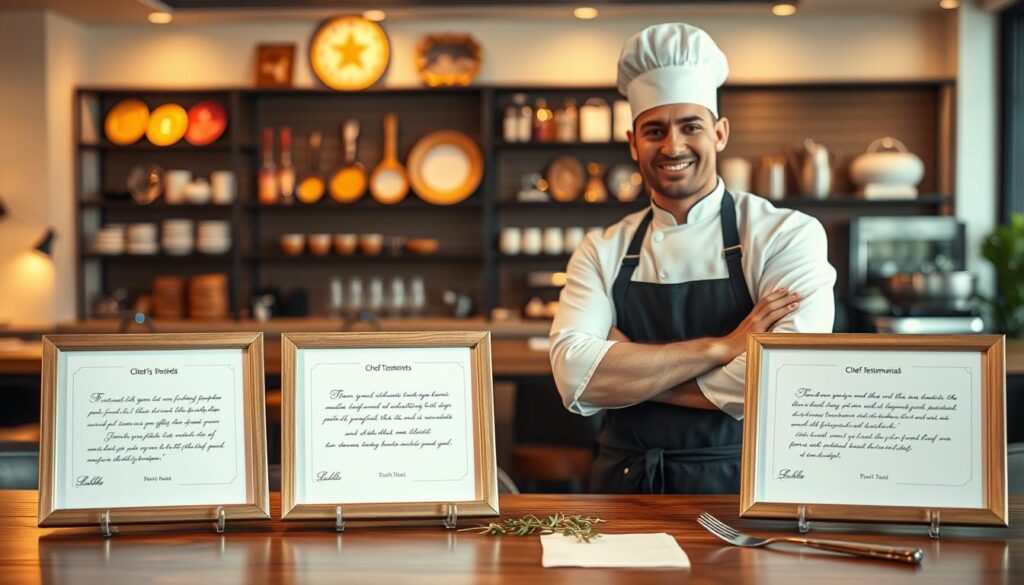
Don’t hide testimonials in a corner of your site. Instead, think of them as a strategic portfolio. Place your best client stories where doubt arises.
Your homepage hero section is ideal. Your private dining and wedding service pages are essential. It’s about showing your reviews in the best light, not hiding them.
Structure is key. A strong testimonial is like a mini-drama. Present it like a case study:
- The Problem: “Our wedding had 12 dietary restrictions, and the original caterer panicked.”
- The Solution: “Chef [Name] didn’t blink. She designed a globally-inspired menu that delighted everyone.”
- The Outcome: “Guests are texting us about the harissa-roasted cauliflower.”
This narrative shows your problem-solving skills, not just your cooking.
For engagement, a picture is worth a thousand Yelp stars. Always ask for a client photo. A genuine smile with your dishes builds trust. A short, candid video of a client saying, “You saved the day!” is powerful.
For written text, keep it short and impactful. Quotes should be around 60 words. Edit to focus on the emotional payoff. Use design cues like larger fonts and bold text to highlight key points.
Share this content everywhere. Your chef credibility portfolio should be across all platforms. Post that case study on Instagram. Use the video testimonial in a Facebook ad. Make your booking platform profile shine with these snippets.
This multi-platform showcase creates a strong narrative of excellence. It tells future clients that their event is in good hands.
Video vs. Written Testimonials
Written testimonials are like a well-crafted sonnet, while video testimonials are like an impromptu jazz solo. Both are forms of art, but one feels more alive. The data shows that video testimonials are 89% more effective at building trust than written ones. So, is the written word obsolete? Not even close.
Think of written chef testimonials as your permanent record. They are like sworn affidavits in your culinary court case. A guest might say, “The steak was perfectly cooked.” It’s elegant, portable, and great for Google’s algorithms. People can skim it, quote it, and it lives forever on a review site.
Video testimonials, on the other hand, are like eyewitness testimony. They capture the unscriptable moments. The data points to this raw authenticity. It’s not just about hearing that the food was great. It’s about seeing the guest’s eyes close in bliss, the genuine smile, the hand gesture that says, “I’m speechless.” That’s a transformation no paragraph can fully convey.
Let’s get specific. A written review for a chef might say, “The dessert was innovative.” A video review shows the fork shaking, the slow-motion head shake of disbelief, the spontaneous “Oh my god.” Which one makes you believe the chef is a genius? Which one makes you want to book a table tonight? The video does the heavy lifting of emotional proof.
The choice isn’t either/or. It’s strategic. Use written testimonials for your foundation. They are your SEO workhorses and your quick-hit credibility. Use video for the knockout punch. Deploy it on landing pages, social media, and email campaigns where you need to convert hesitation into action.
| Attribute | Video Testimonials | Written Testimonials |
|---|---|---|
| Emotional Impact | High. Conveys tone, facial expressions, and raw reaction. | Moderate. Relies on the reader’s imagination and descriptive skill. |
| Authenticity & Trust | Extremely High (89% more effective). The human element is undeniable. | High. Perceived as thoughtful and permanent, but easier to fake. |
| Production & Effort | Higher barrier. Requires filming, maybe editing. Can feel more staged. | Low barrier. Easy for clients to provide; easy for you to publish. |
| SEO & Discoverability | Indirect. Engages users, reducing bounce rates. Needs proper titles and descriptions. | Direct. Text is crawlable by search engines, feeding keyword relevance. |
| Ideal Platform | Homepage hero sections, social media ads, sales pitches. | Google Business Profile, website testimonial pages, email signatures. |
So, what’s the verdict? Don’t choose between Tolstoy and Tarantino. Publish the novel and direct the blockbuster. Let your written reviews build the case logically. Let your video testimonials deliver the emotional verdict. A robust strategy uses both to tell the complete story. Your collection of chef testimonials should be a multi-sensory experience, not a one-note press release.
Leveraging Google/Yelp
In today’s world, your chef reputation isn’t just talked about in kitchens. It’s shared online on Google and Yelp. These sites are where people share their opinions. Your star rating is like a permanent record of what people think.
Every good review helps your local SEO ranking. Search engines like consistent and many reviews. This shows you’re trustworthy. It also helps your Google Ads work better, making your business more visible.
Google My Business and Yelp turn feedback into public proof. They help people see what others say about you. This is your biggest strength. It shows your real skills, not just marketing.
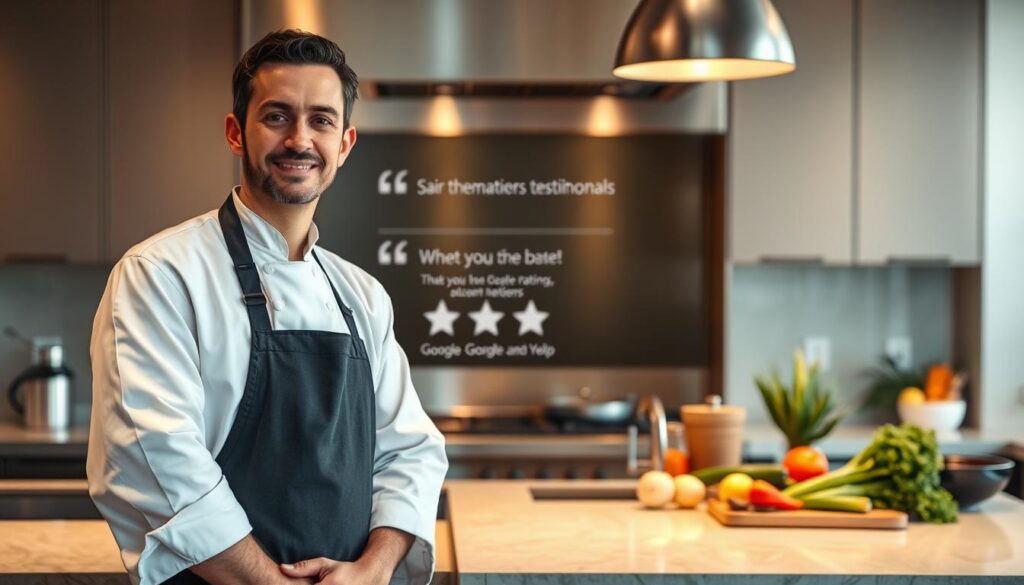
This creates a cycle that helps you. More good reviews mean you’re seen as credible. Being credible makes you more visible. More visibility means more people find you. And those people can share their own reviews.
Your profile on these sites is like your online store. A blank or bad one looks like you’re closed. To use them well, claim and improve your listings. Ask happy customers to share their stories there. For more tips, check out online marketing for small businesses.
Mastering Google and Yelp is key for chefs today. It’s where people first see you. Your cooking deserves an audience. These sites give you the stage and the voice to reach them.
Dealing With Negative Feedback
In the culinary world, a bad review can hurt more than a misjudged chili pepper. But for the savvy chef, it’s a powerful tool in your chef testimonials arsenal. Let’s look at it differently. That one-star Yelp review is not an attack; it’s a chance to learn where you fell short. Ignoring it is like ignoring a smoke alarm.
Your response to a bad review shows you’re listening and care. It’s a chance to show you’re accountable. I’ve seen restaurants turn a bad review into a showcase of their customer service. They often win over more people with their thoughtful reply than they lost with the initial complaint.
Never ignore a negative review. Silence is seen as arrogance or indifference. A thoughtful, public response can actually improve your standing. It shows you’re committed to making your guests happy, more than glowing reviews can.
For example, a complaint about a cold dish is a chance to show your quality. Outline your temperature-check protocols. Thank the reviewer and invite them back to see the difference. You’ve turned a failure into a proof of your standards.
A complaint about a steak being overdone is a chance to show your process. This public display of accountability is more valuable than many positive reviews. It shows you’re dedicated to quality.
So, how do you turn a bad review into a positive one? A great reply has specific parts. The table below shows how to turn a disaster into a demonstration in your chef testimonials.
| Component | The Defensive Disaster (What Not to Do) | The Stellar Response (What to Do) |
|---|---|---|
| Acknowledgment | “I find it hard to believe our food was cold.” | “Thank you for bringing this to our attention. We take temperature control very seriously.” |
| Empathy | “You must have been sitting near a draft.” | “We’re sorry your meal did not meet the warm, enjoyable experience we strive for.” |
| Solution & Explanation | “Our kitchen is always perfect.” | “Our protocol requires all plates to pass a infrared thermometer check. We will investigate this lapse immediately.” |
| Professionalism | “This seems like a personal vendetta.” | “We value all feedback as it helps us improve. Please contact our manager directly to discuss this further.” |
| Follow-up Invitation | “Maybe you should try a different restaurant.” | “We would be honored to have another opportunity to serve you a meal that reflects our true standards.” |
Notice the difference? The right column doesn’t just admit fault. It takes ownership of the experience. It’s specific, professional, and turns a critique into a display of integrity.
Every negative review is a free, honest focus group for your chef testimonials. An angry post about slow service? It’s a spotlight on your staffing. A comment on bland seasoning? It’s a note on your taste. This is valuable data you’d pay a consultant for.
In the end, your response to criticism is louder than any praise. It shows how you operate under pressure. It proves you’re not just a chef, but a professional in public opinion. Now, that’s a story worth telling.
Updating Regularly
A testimonial from five years ago is like a five-year-old news headline—interesting history, but irrelevant to today’s reality. In the fast-paced world of online perception, your reviews for chefs are your credibility’s live news feed, not its archived history section.
Letting accolades gather digital dust doesn’t just date you; it subtly screams stagnation. A client praising your “innovative” menu from 2019 might as well be praising the flip phone. Updating isn’t vanity; it’s vitality. It signals you’re active, your skills are sharp, and clients are happy.
The magic is in rotation and variety. A static wall of praise from one type of event makes you look like a one-trick pony. I suggest a quarterly review ritual. Retire the oldest raves. Promote the freshest wins. This creates a dynamic portfolio that shows consistent excellence.
For a chef, this means showing a range. Don’t just highlight wedding plaudits. Mix in corporate catering kudos, intimate dinner party raves, and vegan tasting menu reviews for chefs. This proves your versatility and genius in different settings.
Stale testimonials are like stale bread. They hint at a larger, unappetizing problem. Fresh, varied reviews for chefs prove your kitchen and reputation are open for business.
Conclusion
In the digital world, trust is everything. Testimonials are not just fancy quotes for your website. They help build trust online, turning visitors into loyal customers easily.
We’ve explored how to create social proof. From asking for feedback to showing it off on Google and Yelp, each step builds trust. For chefs, this isn’t about showing off. It’s about chef credibility, built on real feedback from happy customers.
This idea works for many professions. Whether you’re a lawyer, artist, or consultant, your work speaks for itself. Your clients’ words can make a big impact. Positive or negative, their feedback is your best content.
Don’t just collect testimonials. Curate them carefully. Use them to show your trustworthiness and keep your promises. Now, go make your case.